
Mastery Martial Arts · Troy, MI
Screen Time vs. Martial Arts: What Active Kids Really Gain
When you weigh screen time vs. martial arts, you are not really choosing between two activities — you are choosing what fills your child’s afternoon, and what kind of rewards their brain learns to chase. Here is what kids actually gain in the hours they trade the screen for the mat.
Mastery Martial Arts • Troy, MI
Screen-Time GuideScreen Time vs. Martial Arts: The Real Trade-Off
Both a screen and a martial arts class can hold a child’s attention for an hour. The difference is what each one gives back. A game is engineered to deliver constant, effortless stimulation — and to make stopping feel bad. A class is built to deliver something harder and far more valuable: real skill that your child earns with their own effort. Same hour, very different return.
An hour of screens gives…
- Fast, passive stimulation
- Fake progress (levels, badges, loot)
- Dopamine hits with no effort
- A meltdown when it’s time to stop
- Restlessness once it’s off
An hour on the mat gives…
- Focus that has to be practiced
- Real progress (skills, belts, broken boards)
- Reward that follows genuine effort
- A calmer, more tired-out kid
- Friends who notice when they show up
Neither screens nor martial arts is the enemy here. But if your child is spending most of their free time on the left column, it is worth deliberately adding more of the right.
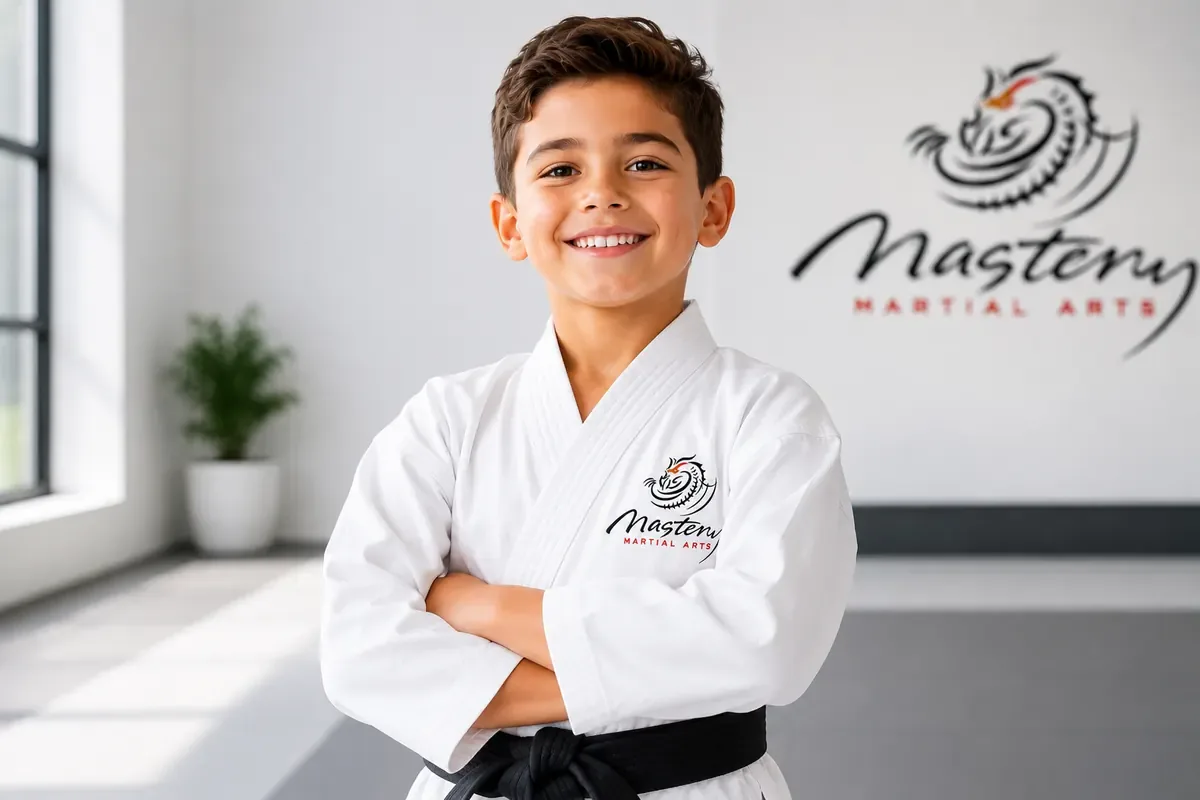
5 Things Kids Gain When Screens Become Training Time
1. Focus they can actually control
Screens train attention to jump every few seconds. Martial arts trains the opposite — standing still, listening, holding a stance, finishing a form. That ability to direct attention on purpose is the same muscle kids use to sit through class and finish homework. Parents often notice it first in school reports.
2. Confidence that comes from doing hard things
You cannot fake your way to a new belt. When a child sets a goal, struggles, and finally nails the technique, they collect proof that effort pays off. That proof is real in a way a game’s reward never is, and it travels with them off the mat.
3. Physical energy with somewhere to go
High-energy kids do not do well sitting still all day and then sitting still on a couch all evening. Training burns the restlessness that otherwise gets poured into screens — and it usually makes bedtime easier too. The broad benefits of daily physical activity for children are well documented by the American Academy of Pediatrics.
4. Real friendship and belonging
Games offer a feed of strangers and avatars. A class offers the same faces every week, a team that cheers each other on, and instructors who know your child’s name. For a lonely or shy kid, that belonging is often the biggest win of all.
5. Self-control under pressure
Martial arts deliberately puts kids in small, safe moments of pressure — a test, a spar, a board to break — and teaches them to breathe and stay calm. That is the exact skill that shrinks the “screens off” meltdown over time.
This Isn’t About Banning Screens
The point of comparing screen time vs. martial arts is not to demonize technology. Screens are part of childhood now, and that is fine. The goal is balance: a child who trains a couple of times a week, moves their body, and has real friends can enjoy a show or a game without it running their whole week. When the good stuff is on the calendar, the screen quietly loses its grip — no daily battle required.
The bottom line: You are not trying to take something away. You are giving your child something better to say yes to — and active kids put screens down more easily because they actually have somewhere to be.
What Parents in Troy Tell Us
When families first compare screen time vs. martial arts, the worry is always the same: “My kid will hate it — they only want their tablet.” Then a few weeks in, the texts change. Bedtimes get easier because there is finally enough real physical activity in the day. Homework arguments shrink as focus improves. And the child who used to melt down at “screens off” starts asking when the next class is. None of that happens by taking the screen away — it happens by giving them something that finally feels worth showing up for.

Keep Reading
Part of our complete guide to screen time for kids:
→ Screen Time and Kids: The Complete Parent’s Guide→ Why Boys Need Physical Activity (Not More Screens)→ iPad Kids vs. Active Kids: The Real Difference
About the Author
Denny Strecker, Chief Instructor
Denny Strecker owns and leads Mastery Martial Arts in Troy, Michigan, where he has spent 34+ years teaching kids the focus, confidence, and self-control that screens can’t. He has personally coached thousands of local children and created the Personal Power Pathway™ curriculum. He is a dad too — this is the advice he gives the parents in his own lobby.
Screen Time vs. Martial Arts: Common Questions
Is martial arts really better than screen time for kids?
It is not that screens are “bad” and martial arts is “good.” It is that an hour of training builds focus, confidence, fitness, and friendship, while an hour of passive screen use builds none of those. The healthiest setup is plenty of the first so a little of the second stays harmless.
How many days a week should my child train?
For most kids, two classes a week is plenty to see real gains in focus and energy without overloading the family schedule. The key is consistency — a regular rhythm your child looks forward to.
My child only wants to play video games. Will they even like martial arts?
Very often the most screen-attached kids end up loving the mat, because it finally gives them the challenge and progress that games only imitate. A no-pressure trial class is the easiest way to find out.
This article is for general educational purposes and is not medical advice. If you are concerned about your child’s screen use, sleep, or mood, please talk with your pediatrician.
Free Class · Troy, MI
See it for yourself.
Bring your child in for a free introductory lesson and 30 free days. No obligation to continue.
Get My Child’s Free 30-Day Pass →3656 Rochester Road, Troy · (248) 247-7353
For Parents
See our answers first on Google
Google now lets you choose the websites you trust most. The ones you choose move to the top of your search results. Add us, and our articles on focus, confidence, and bullying show up first, right when you’re looking for help. It takes ten seconds, and you can undo it anytime.
Make Us a Preferred SourceOpens Google. Tap the search box, then check the box next to “Mastery Martial Arts - Troy.”