
Mastery Martial Arts · Troy, MI
Frustration Tolerance in Children: The Skill Behind Quitting, Meltdowns, and Homework Battles
The crumpled homework. The abandoned hobby. The controller thrown at the couch. The instant “I can’t do it” before they have really tried.
If that is your house, the missing skill has a name: frustration tolerance. After 34 years of teaching children in Troy, I think it is the most underrated skill in childhood.
What Frustration Tolerance Actually Is
Frustration tolerance is your child’s ability to stay in the game when something is hard, slow, annoying, or not going their way. It is the gap between “this is difficult” and “I quit.” In some kids that gap is an ocean. In others it is a puddle.
Here is why it matters more than almost anything else you could work on. Nearly everything worth learning sits on the far side of frustration. Reading, math, friendships, sports, instruments. Every one of them makes your child be bad at it first.
A child with low frustration tolerance is not short on ability. They cannot reach their ability, because they leave at the first sting of difficulty. Ask any teacher. The child who can sit in frustration will out-learn the clever child who cannot.
This is not a soft skill. Harvard’s Center on the Developing Child groups frustration tolerance with executive function and self-regulation, the mental control system behind focus, planning and impulse control. Their conclusion matches what I see on the mat: these are skills built through practice and coaching, not traits a child is born with or without.
Signs of Low Frustration Tolerance
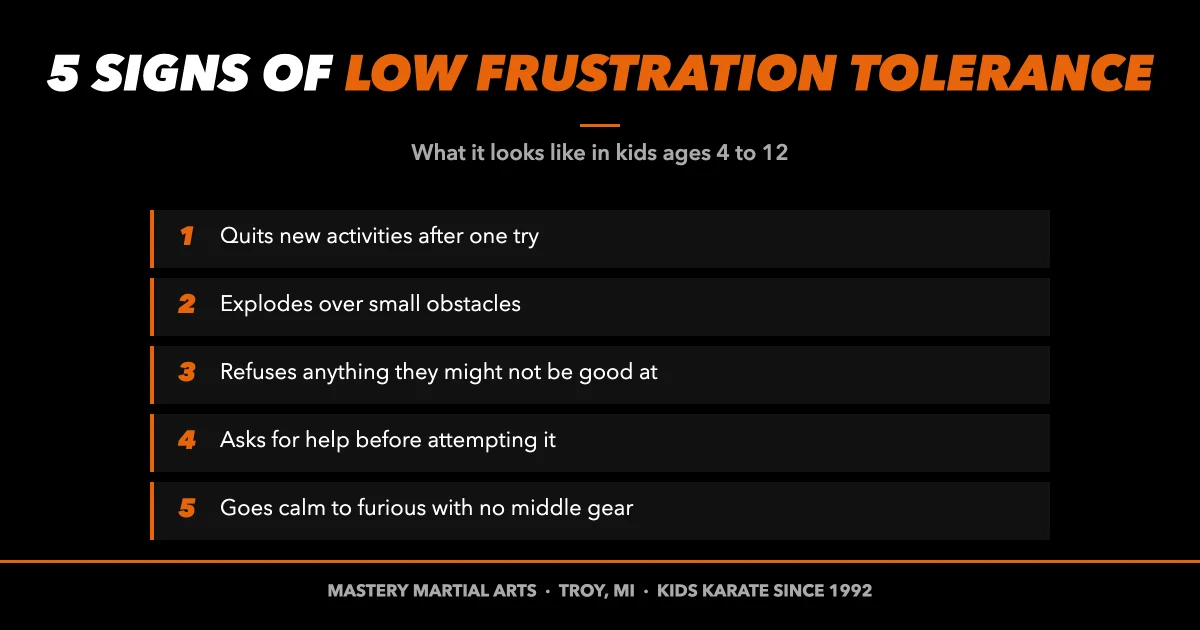
- Quits new activities almost at once (“I hate soccer,” after one practice)
- Explodes over small obstacles: homework, tangled laces, a level they cannot beat
- Refuses to try anything they might not be instantly good at
- Asks for help before attempting it
- Goes from calm to furious with no middle gear
Where It Comes From
Some of it is temperament. Kids arrive with different settings, and that part is not your doing.
Most of it is practice, or the lack of it. Two things quietly starve this skill.
Instant everything. A childhood of on-demand entertainment offers almost no natural reps at waiting or struggling.
Loving, efficient parents. This one is harder to hear. Every time we untangle the knot, finish the puzzle, or step in at the first whimper, we teach that frustration is an emergency somebody else solves. The muscle never lifts anything.
Why Bright Kids Have the Shortest Fuses
Parents of capable kids find this the most confusing part. Your child reads above grade level, picks things up fast, asks questions that startle adults. Then one hard worksheet arrives and the whole thing collapses. “I’m stupid. I quit.”
How does a kid this capable have a fuse this short?
I have watched this pattern hundreds of times, and it holds together logically. The frustration is not happening despite your child being bright. Often it happens because of it. Three things are going on.
Easy early wins mean no practice struggling
Think about a bright child’s first years. Letters, numbers, puzzles, early school, all of it arrives fast. While other kids are practicing the experience of trying, failing, and trying again, the quick learner skips that gym completely. They collect achievements. They do not collect reps.
Frustration tolerance is a muscle and it only grows under load. So a child reaches 7 or 8 with a sharp mind and an untrained frustration muscle. Then long division shows up, or piano, or a sport. Effort is required for the first time, the feeling of not immediately getting it is brand new, and it is frightening.
“Smart” becomes an identity to protect
This is the more damaging one. When a child hears “you’re so smart” enough times, being smart becomes who they are. Once it is an identity, struggle turns into a threat.
Follow the logic your child is running: smart kids get things right away. I’m not getting this right away. So maybe I’m not smart.
That is why bright kids often refuse to try at all. Quitting protects the identity, because you cannot fail at something you never attempted. If your child suddenly hates everything they are not instantly good at, this is usually what sits underneath.
The brain runs ahead of the emotions
A child can be intellectually 10 and emotionally 7 in the same body. Development is uneven. Bright kids often know exactly what they should be capable of, because their standards are adult-sized, while the equipment for handling that gap is still child-sized. Adult standards plus child coping skills produces explosions.
How to Build It at Home
Wait before you rescue. When your child hits a wall, count to thirty before stepping in. Then offer the smallest hint that helps, not the answer.
Praise the persistence, not the brain. “You stuck with that even when it was annoying” builds a child who goes looking for challenge. “You’re so smart” builds one who avoids it. This is the single highest-leverage change most families can make.
Use the word “yet.” “I can’t do it” becomes “you can’t do it yet.” Small word, different brain.
Struggle out loud yourself. Let your child watch you fight with something and stay with it. Say it plainly: “This is hard for me. I’m going to keep going.”
Let boredom and waiting exist. Not every car ride needs a screen. Small doses of tolerable discomfort are reps.
Pick one thing that cannot be rushed. Every child needs one pursuit where progress is slow, earned, and impossible to fake. Bright kids need it most, because they need one arena where being clever does not let them skip steps.
The Power of Structured Practice
That last one is where martial arts has no real equal. The whole system runs on earned, incremental struggle. A technique that takes weeks. A stripe that has to be waited for. A belt nobody can buy, rush, or charm out of an instructor.
You cannot think your way to a black belt. For a lot of bright kids, that makes our floor the first place in their life where effort is the only currency that works.
At Mastery Martial Arts in Troy, kids meet frustration in small, survivable doses two or three times a week, with an instructor right there coaching them through the moment instead of lifting them out of it. They name it, breathe through it, and go again.
Over months, parents watch the puddle turn into a pool. Homework battles shrink. New activities stop being frightening. “I can’t” becomes “not yet.” And the identity shifts from “the kid who’s smart” to “the kid who can do hard things.”
Frustration tolerance is one piece of the larger skill of emotional regulation. For the whole picture, including the brain science and what to expect at each age, read our complete guide to Emotional Regulation for Kids in Troy, MI. Two related guides go deeper on specific moments: tantrums vs. meltdowns and why some kids cry when they lose. More tools sit on our Parent Resources hub.
Build the Muscle That Builds Everything Else
Frustration tolerance grows through practice, and practice needs a place. Troy families have trusted ours since 1992.
Kids karate classes in Troy, MI for ages 3 to 17.
▶ Get Your Free 30-Day PassFree Class · Troy, MI
See it for yourself.
Bring your child in for a free introductory lesson and 30 free days. No obligation to continue.
Get My Child’s Free 30-Day Pass →3656 Rochester Road, Troy · (248) 247-7353
For Parents
See our answers first on Google
Google now lets you choose the websites you trust most. The ones you choose move to the top of your search results. Add us, and our articles on focus, confidence, and bullying show up first, right when you’re looking for help. It takes ten seconds, and you can undo it anytime.
Make Us a Preferred SourceOpens Google. Tap the search box, then check the box next to “Mastery Martial Arts - Troy.”