
Mastery Martial Arts · Troy, MI
Tantrum vs Meltdown: How to Tell the Difference (and What Helps)
The difference between a tantrum and a meltdown comes down to one thing: control. In a tantrum, your child still has some. In a meltdown, your child has none. A tantrum stops when the goal is met or the audience walks away. A meltdown keeps going even after you hand over the exact thing your child was screaming for.
Knowing which one you are looking at changes what you should do next. Handle a meltdown like a tantrum and you make it worse.
You ask your child to put their shoes on and thirty seconds later you are in a war zone. Screaming. Tears. Something gets thrown. You stand there wondering what you did wrong. After 34 years of teaching kids at Mastery Martial Arts in Troy, I have had this conversation with thousands of parents. Your child is not broken, spoiled, or playing you. Something mechanical is happening inside their head, and once you can see it, the next twenty minutes get a lot easier.
Tantrum vs Meltdown: 5 Ways to Tell Them Apart
Parents use the two words as if they mean the same thing. They do not. Here is the tantrum vs meltdown difference in plain terms:
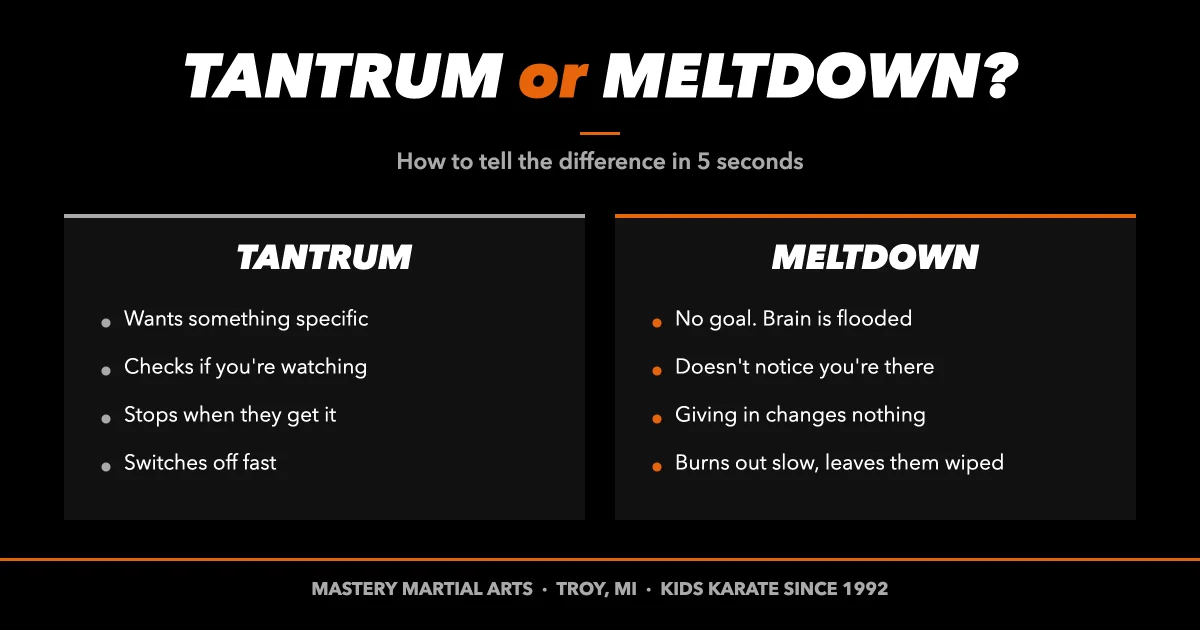
| What you see | Tantrum | Meltdown |
|---|---|---|
| The goal | Your child wants something | No goal. The system is overloaded |
| The audience | Checks to see if you are watching | Does not notice or care who is there |
| Giving in | Stops it fast | Changes nothing |
| The ending | Switches off, sometimes in a second | Burns out slowly, leaves your child wiped out |
| Afterward | Moves on like nothing happened | Often embarrassed, sorry, or exhausted |
That last row tells you the most. A child who feels awful afterward was not running a strategy on you. They lost the wheel and they know it.
What Happens in Your Child’s Brain During a Meltdown
The feeling part of your child’s brain runs at full power from toddlerhood. The braking part, the prefrontal cortex that handles impulse control and thinking ahead, does not finish wiring until the mid-twenties. When a feeling gets big enough, it floods the system and the thinking brain drops off the call.
Your child cannot reach logic, language, or consequences in that moment. Not will not. Cannot.
This is why reasoning with a melting-down child never lands, and why “use your words” is the least useful sentence in parenting. You are talking to a phone nobody is picking up.
Why Your Child Holds It Together at School and Falls Apart at Home
This one confuses parents more than anything else. The teacher says your child is a delight. Then the car door closes and you get a different kid entirely.
Your child spent six hours holding it in. Sitting still, waiting turns, reading faces, following rules, managing a friendship problem at lunch. That takes effort, and the tank runs low. Home is the one place your child feels safe enough to let go.
Read that again, because it is good news wearing a bad disguise. Your child falls apart in front of you because you are the safe one. It is not a verdict on your parenting.
What helps: a landing pad instead of a to-do list. Food in the first ten minutes. No questions about homework, the spelling test, or who they sat with. Twenty quiet minutes of nothing. Most families see the after-school explosions shrink once the first half hour stops being an interrogation.
What Meltdowns Look Like at Each Age
The shape changes as kids get older. Knowing what is normal for the age keeps you from panicking about something ordinary.
Ages 4 to 5
Loud and physical. Dropping to the floor, kicking, throwing. Triggered by tiny things: the wrong color cup, a banana broken in half. At this age the braking system barely exists yet, so the gap between feeling and action is close to zero. Frequent meltdowns here are standard equipment.
Ages 6 to 7
The hardest stretch for most families I work with. Full-day school arrives, the demands jump, and your child now has enough self-awareness to feel humiliated afterward without having enough control to prevent it. Meltdowns here often hit at homework, bedtime, or right after pickup.
Ages 8 to 10
Less floor-kicking, more door-slamming and “I’m stupid, I quit.” Perfectionism starts driving the bus. A missed shot, a hard math page, or losing a game can trigger a collapse that looks like rage but runs on shame.
Ages 11 to 12
Shorter, sharper, and more verbal. Your child may storm off and reappear an hour later acting normal. At this age the meltdown usually arrives loaded with something social from earlier in the day that you never heard about.
The Triggers Behind Most Meltdowns
Meltdowns look like they come from nowhere. They rarely do. What you see, the broken cracker or the wrong cup, is the last drop in a bucket that has been filling since breakfast. The real filler:
- Hunger and tiredness. The boring answer is usually the right one. A tired, hungry brain has almost no braking power. Track the clock for a week and you will spot the pattern.
- Transitions. Screen time ending. Leaving the park. Play to homework. Kids’ brains change gears slowly, and you are asking for an instant shift.
- Sensory and social overload. Noise, crowds, a birthday party, a long day of holding it together.
- Frustration with a task. Common in bright kids and perfectionists. A LEGO build that will not cooperate can empty the bucket in seconds.
- Too little say in anything. Kids who spend the whole day being told what to do will make a stand somewhere, and it is usually over something small.
What to Do While It’s Happening
Your job during a meltdown is not to teach. It is to help your child’s nervous system come back online. Four things:
1. Slow yourself down first. This is the hardest part and it matters more than the rest combined. Kids borrow calm from the nearest adult. If your voice climbs, so does theirs.
2. Cut your words in half, then half again. Long explanations pour fuel on it. Go short, low, and slow: “I’m here.” “You’re safe.” “I’ve got you.”
3. Drop the demands until the wave passes. No apologies, no cleanup, no “look at me” while your child is underwater. All of that can wait.
4. Stay close and let it burn out. Keep everyone safe, stay nearby, say little. Most meltdowns end faster when nobody is feeding them.
What to skip: threats, counting to three, sending your child to their room to “calm down alone,” and any question that starts with why. None of those reach a flooded brain.
What to Do After (This Is the Part That Changes Things)
Once your child is calm for real, which might be twenty minutes later or after dinner, you get your teaching window. Keep it to three steps and under two minutes.
Name it. “You got really frustrated when the tower fell.”
Find it in the body. “Where did you feel it? Did your hands get tight? Did your face get hot?” Kids who can feel a meltdown coming can start to head one off. Kids who cannot are passengers.
Rehearse the next one. “Next time your hands get tight, what could we try first?” Let your child pick the plan. A plan they choose is a plan they might use.
One conversation changes nothing. Fifty of them, backed by real practice, change everything.
When Meltdowns Point to Something Bigger
Most meltdowns are normal development running its course. Talk to your pediatrician if you see:
- Meltdowns that stay frequent and intense past age 8 or 9
- Episodes lasting well over 30 minutes on a regular basis
- Your child hurting themselves or others
- Blowups at school as well as home
- Your child seeming genuinely frightened afterward, or unable to remember it
Underneath frequent, severe meltdowns you will sometimes find ADHD, anxiety, a learning difference, or sensory processing struggles. None of that means anything is wrong with your child, and all of it responds better to early help. The American Academy of Pediatrics has solid guidance on when outbursts warrant a closer look. If ADHD is on your mind, we wrote a separate guide on karate for kids with ADHD.
How to Get Fewer Meltdowns Over Time
Protect sleep. Feed them before the tank hits empty. Warn before transitions instead of announcing them. Give your child real choices during the day so they are not saving up a stand to make.
Then there is the piece most families never get to: your child needs practice handling frustration before it swamps them. Emotional control grows through reps under safe pressure. It does not grow through lectures, and it does not grow during a meltdown, when the learning part of the brain is offline.
That practice is hard to manufacture at home, because home is where you protect your child from frustration rather than hand it to them on purpose. Our guide to frustration tolerance in children goes deeper on building that muscle.
What 34 Years on the Mat Taught Me About Meltdowns
A well-run karate class is a frustration machine, on purpose. A kick your child cannot land yet. A form they keep forgetting halfway through. A turn they have to wait for while somebody else goes first. Small, survivable doses, with an instructor standing right there to coach them through the exact moment it gets hard.
Violet came to us at 7. Sweet kid, quiet, glued to her mom. She melted down inside the first few minutes of her first class, standing in place with her fists at her eyes, crying. Second class, same thing about ten minutes in. Too loud, too fast, too much.
A couple of months later her mom told us the meltdowns in class had mostly stopped. What surprised her more was school: Violet started joining group discussions and brought home a positive office referral. At home she started taking on chores without being asked. At her first belt test she needed a second run at it, did it with her instructor beside her, and finished. You could watch her grow two inches standing still. Her full story is here.
Violet is one kid, not a promise. What I can tell you after 34 years is that the skill built on the mat comes home. Parents notice it first in the car ride and at bedtime.
Questions Parents Ask
At what age do kids stop having meltdowns?
Most kids see them drop off sharply between ages 7 and 9, as the brain’s braking system builds capacity. They rarely stop on a birthday. Expect them to get shorter and less frequent before they disappear, and expect a temporary spike whenever life gets loud: a new school, a new sibling, a move.
How do I deal with a child who is having a meltdown right now?
Lower your own voice first. Say less than feels natural. Drop every demand until it passes. Keep your child safe, stay within reach, and wait it out. Save the teaching for after they are calm.
What is the hardest age for meltdowns?
For classic tantrums, ages 2 and 3. For the school-age meltdowns parents ask me about most, ages 6 and 7. Full-day school arrives, the demands stack up, and your child is now old enough to feel embarrassed afterward without being old enough to stop it.
What does an ADHD meltdown look like in a child?
Faster to arrive, bigger than the trigger, and longer to come down from. Parents often describe zero to sixty with nothing in between, and a child who cannot switch off the emotion even once they want to. If that sounds like your house, start with your pediatrician. Our guide on karate for kids with ADHD covers what helps on the activity side.
Fewer Meltdowns Start With Practice
For the full picture of how emotional control develops at every age, read our complete guide to Emotional Regulation for Kids in Troy, MI. For more tools, visit our Parent Resources hub.
Or give your child a place to build the skill for real, with instructors who have been coaching Troy kids through hard moments since 1992.
Kids karate classes in Troy, MI for ages 3 to 17.
▶ Get Your Free 30-Day PassFree Class · Troy, MI
See it for yourself.
Bring your child in for a free introductory lesson and 30 free days. No obligation to continue.
Get My Child’s Free 30-Day Pass →3656 Rochester Road, Troy · (248) 247-7353
For Parents
See our answers first on Google
Google now lets you choose the websites you trust most. The ones you choose move to the top of your search results. Add us, and our articles on focus, confidence, and bullying show up first, right when you’re looking for help. It takes ten seconds, and you can undo it anytime.
Make Us a Preferred SourceOpens Google. Tap the search box, then check the box next to “Mastery Martial Arts - Troy.”