

Mastery Martial Arts · Troy, MI
Do Kids Spar in Karate? What Contact Really Looks Like at Each Age and Belt
“Do kids spar in karate?” is really three questions: when does contact start, how protected is my child, and can we opt out? Here are all three answers, age by age.
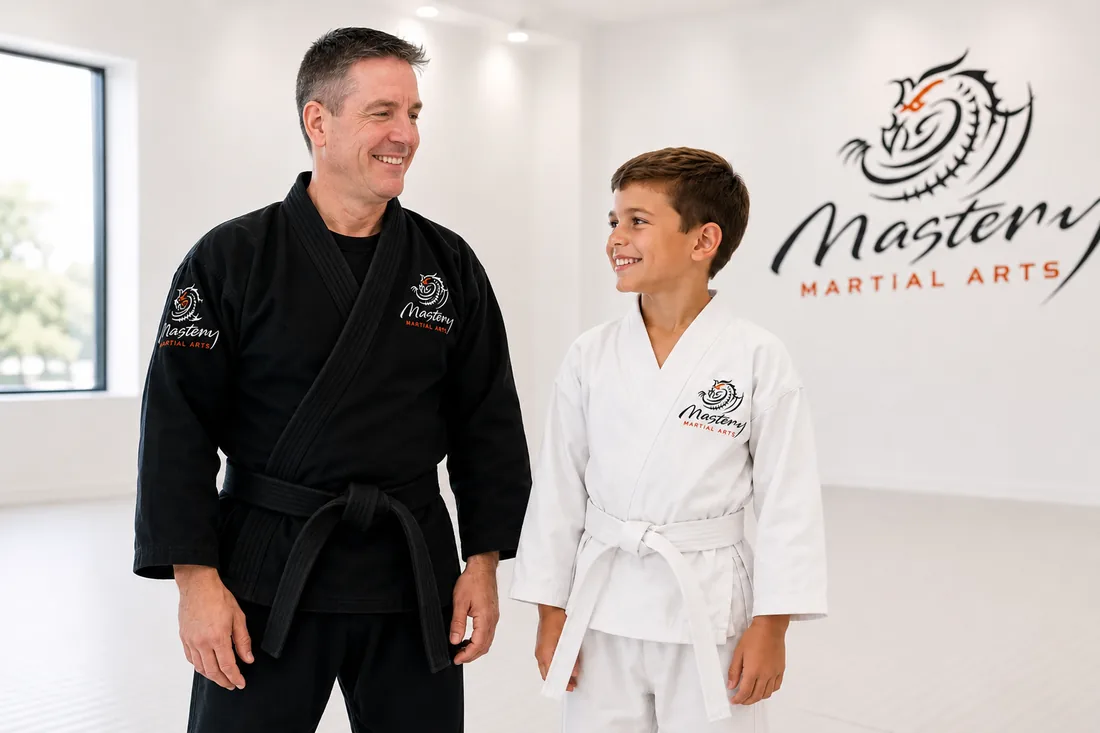
When parents tour our Troy school, there’s a moment I can predict: they watch the little kids doing pad drills, relax, and then see two older students in headgear touch-sparring across the room — and every muscle in their face changes. So let’s walk through exactly what sparring is, when it starts, what it looks like at each stage, and the questions that tell you whether a school handles it responsibly.
First, What Sparring Actually Is (and Isn’t)
Sparring in a children’s karate program is a structured partner exercise where two students practice techniques against a moving, unpredictable target — each other — under strict rules and an instructor’s direct supervision. In point-based systems like ours, the goal is to touch a scoring zone with a controlled technique, not to hit hard. Think fast, padded tag with rules, not a fight. (The American Academy of Pediatrics overview of martial arts draws the same line: controlled, supervised practice is where the benefits live.) What it teaches is real: timing, distance, composure under pressure, and reading another person — the exact skills that make self-defense functional instead of theoretical.
The point of kids’ sparring isn’t landing hits. It’s staying calm, thinking, and controlling your body while someone unpredictable moves toward you. That skill shows up later in every stressful moment of their life.
Do Kids Spar in Karate? The Age-by-Age Answer
Ages 3–6: No. Full stop.
Preschoolers never spar in a legitimate program. Classes are pads, targets, games, and drills — children this age never strike each other. (Our complete preschool karate guide covers what they do instead.) A school that spars its 5-year-olds is a school to walk out of.
Ages 7–9: Pre-sparring skills, no free contact
Kids at this stage do choreographed partner drills: block-and-counter sequences at slow speed, footwork games, distance drills with pool noodles and paddles. They’re learning the grammar of sparring with zero of the contact. Everything is scripted; nobody improvises strikes at a partner.
Ages 10+: Introduction to controlled sparring — gradually, geared, and refereed
When students are ready — which is a control-and-maturity judgment, not just an age — sparring is introduced in stages: gear first (headgear, foam gloves and boots, mouthguard, chest protector where used), then slow-motion rounds, then light point sparring with an instructor refereeing at arm’s reach. Contact is regulated to light touch; head contact rules are stricter still; and a student who can’t control their power sits down. Control failures are treated exactly like safety violations, because they are.
Can My Child Skip Sparring Entirely?
So — do kids spar in karate at every school, no matter what? In our school: yes, sparring exists — and no, your child does not have to do it. Sparring is one training tool, not the point of martial arts, and students can train to advanced ranks while doing only the drill-based versions. Some kids fall in love with sparring and join the competition team; others prefer forms, board breaking, and leadership training. Both paths build the confidence and discipline parents came for. Any school that requires heavy sparring from young kids has confused its priorities — and it’s worth asking about before you enroll anywhere.
Do Kids Spar in Karate at THIS School? 5 Questions to Ask
- “At what age and belt does sparring start, and what has to happen first?” Good schools have a specific gate: age, rank, and demonstrated control.
- “What gear is required, and who provides and checks it?” The full kit — headgear, mouthguard, gloves, boots — should be non-negotiable.
- “What level of contact is allowed, and how is it enforced?” Listen for the words “light touch,” “point,” and “control” — and for consequences when kids exceed it.
- “Who referees, and how many pairs spar at once per instructor?” A ratio problem here is a safety problem.
- “Is sparring optional?” The answer tells you whether the school develops children or manufactures competitors.
These five fold into the bigger safety picture — injury data, contact policies, school vetting — in our full guide, Is Martial Arts Safe for Kids?, and the school-choice checklist in how to choose a martial arts school.
What Parents Notice After Their Kid Starts Sparring
Here’s the part nobody expects: the kids who benefit most from (properly run) sparring are the cautious ones. A child who has faced a moving opponent at age 11 — heart pounding, brain working, staying composed — recalibrates what counts as scary. Class presentations, tryouts, hard conversations all shrink. Parents tell us their child “stopped panicking under pressure,” and that’s not a coincidence; it’s literally what sparring trains. It’s the same pressure-inoculation effect we describe in how kids learn to handle pressure.
More guides for deciding if martial arts fits your child at our Parent Resources hub.
Free Class · Troy, MI
See it for yourself.
Bring your child in for a free introductory lesson and 30 free days. No obligation to continue.
Start My Child’s Free 30 Days →3656 Rochester Road, Troy · (248) 247-7353
For Parents
See our answers first on Google
Google now lets you choose the websites you trust most. The ones you choose move to the top of your search results. Add us, and our articles on focus, confidence, and bullying show up first, right when you’re looking for help. It takes ten seconds, and you can undo it anytime.
Make Us a Preferred SourceOpens Google. Tap the search box, then check the box next to “Mastery Martial Arts - Troy.”