

Mastery Martial Arts · Troy, MI
7 Martial Arts School Red Flags Every Parent Should Know Before Enrolling
Anyone can open a karate school — no license required. These martial arts school red flags take one visit to spot, and they’ll save you from the wrong program before your child pays the price.
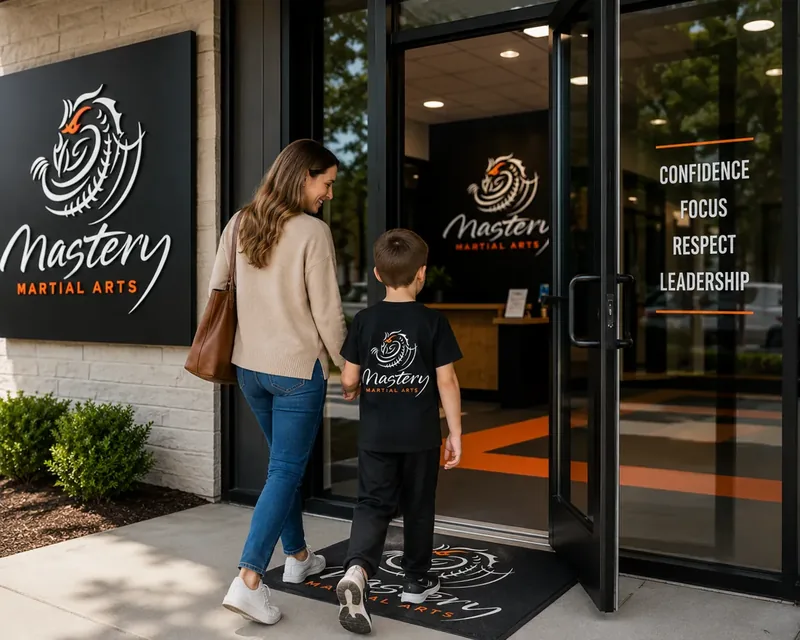
Here’s an uncomfortable truth from inside my own industry: there is no licensing board for martial arts schools. Anyone with a black belt (or without one — nobody checks) can rent a storefront and start teaching children. Most school owners are dedicated professionals. Some aren’t. And because parents usually can’t evaluate technique, the wrong schools survive on great marketing.
The good news: you don’t need to know a roundhouse from a ridgehand to protect your child. Every serious problem shows up in things any parent can observe on a single visit. Here are the seven martial arts school red flags I’d tell my own family to watch for.
Red Flag #1: You Can’t Watch Classes
Any policy that separates you from your child’s training — no viewing area, “parents distract the students,” tinted windows — is disqualifying. Great schools are proud of what happens on the mat and build viewing areas on purpose. There is no acceptable version of “you can’t see how we treat your child.”
Red Flag #2: The Long Contract Before the First Class
A 12–36 month contract pushed at your first visit — often with a “today only” discount — means the school’s business model is built on locked-in payments rather than earned loyalty. A confident school lets your child try real classes first and lets results do the selling. (It’s exactly why we run a risk-free trial instead.) Watch especially for contracts that keep billing after you cancel, and “black belt club” upsells in week one — the FTC’s guidance on fitness contracts applies to martial arts schools word for word.
Red Flag #3: Guaranteed Black Belt (or a Black Belt Price Tag)
“Your child WILL earn a black belt in 3 years” is a promise about revenue, not development. A real black belt is earned at each child’s own pace — that’s the entire reason it means something, as we wrote in why your child’s first black belt matters more than any trophy. Belt promotions on a fixed calendar regardless of skill — every 2 months, every kid, every time — are the same flag flying a different color.
Red Flag #4: Little Kids Doing Big-Kid Contact
Walk out if you see preschoolers sparring, young kids hitting each other without gear, or an instructor treating control failures as toughness training. Contact in kids’ martial arts should be age-gated, padded, and refereed — the full breakdown is in what sparring really looks like at each age and our complete guide to whether martial arts is safe for kids.
Red Flag #5: One Instructor, Thirty Kids, Zero Assistants
Count adults, count kids, do the math. A packed floor with one instructor means most children get supervision only when something goes wrong — and correction, encouragement, and safety monitoring all require eyes. Quality kids’ programs run small classes or staff assistant instructors, and the difference shows in everything from injury rates to how fast your child actually improves.
Red Flag #6: The Culture Test Fails
Of all the martial arts school red flags on this list, culture is the one that never lies, because techniques vary by style and culture doesn’t. Stand in the lobby and listen. How do the teenage students talk to the little ones? Does the instructor correct with patience or humiliation? Do kids look focused-and-happy or drilled-and-nervous? Is respect something everyone practices, or a poster on the wall? Your child will absorb this room — the discipline, or the ego, whichever is actually being taught. In a school doing it right, you’ll see what we describe in how martial arts teaches kids respect.
Red Flag #7: Vague Answers to Direct Questions
Ask three direct questions: “When does contact start?” “What are your instructors’ qualifications for teaching children?” “What happens if my child is struggling or scared?” A professional school answers all three specifically, because it has thought about all three. Vagueness, defensiveness, or a pivot back to the sales pitch tells you the thinking hasn’t been done.
You’re not choosing a sport. You’re choosing the adults who will shape how your child handles difficulty for years. Vet them like it.
What the Green Flags Look Like
Martial arts school red flags have mirror images. Here’s what the good ones look like:
- Open viewing, every class, no exceptions
- Trial programs instead of pressure contracts
- Age-separated classes with age-built curriculums (see our preschool guide for what ages 3–6 should look like)
- Instructors who know every child’s name, school, and struggle
- Belt standards kids are visibly proud of earning
- A straight answer to every question on this list
The full decision framework — questions, comparisons, and how to run a trial visit — is in our guide to choosing the best martial arts school for your child, with more resources on the Parent Resources hub.
Free Class · Troy, MI
See it for yourself.
Bring your child in for a free introductory lesson and 30 free days. No obligation to continue.
Start My Child’s Free 30 Days →3656 Rochester Road, Troy · (248) 247-7353
For Parents
See our answers first on Google
Google now lets you choose the websites you trust most. The ones you choose move to the top of your search results. Add us, and our articles on focus, confidence, and bullying show up first, right when you’re looking for help. It takes ten seconds, and you can undo it anytime.
Make Us a Preferred SourceOpens Google. Tap the search box, then check the box next to “Mastery Martial Arts - Troy.”