
Mastery Martial Arts · Troy, MI
Why Kids Listen to Karate Instructors But Not Their Parents
You’ve seen it through the viewing window: your child, your child, standing at attention, following every instruction. This is why kids listen to karate instructors, and the five mechanics you can take home.
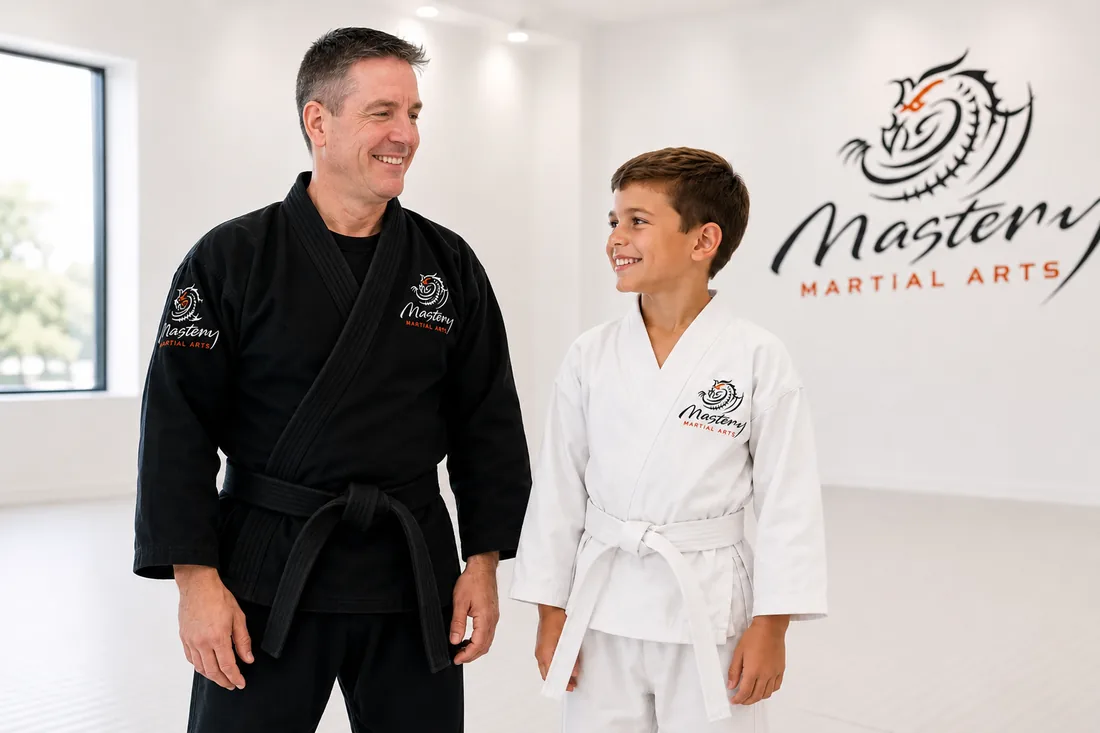
It’s the question Troy parents ask me most, often with a mix of amazement and mild offense: “Why does he listen to YOU?” The honest answer has nothing to do with charisma, a black belt, or a gift with children. It is five learnable mechanics, running inside a structure that makes them easy. After 34 years, here is the full trade secret. Take all of it home.
Why Kids Listen to Karate Instructors: The 5 Mechanics
1. Instructions are scarce, so they’re valuable. In class, an instruction comes once, at normal volume, and something always happens next. At home, instructions arrive in streams of four and five without consequence, so kids learn that the early ones are previews. Scarcity is trainable: say it once, then act (the full method is in what to do when your child ignores you).
2. The relationship runs on respect, not friction. By the time I ask a child to do something hard, I’ve caught them doing ten things right. Most home instruction happens inside an inverted attention economy. Misbehavior gets the energy, cooperation gets silence. Kids work for whoever notices their effort. Flip the ratio for two weeks and watch what happens.
3. The structure does the enforcing. Class has a ritual: everyone knows what happens next and what’s expected during it. Nobody negotiates warm-ups. When expectations live in the routine instead of in momentary parental willpower, kids stop testing them, because there is nothing to test (what happens in a kids martial arts class shows how that routine gets built).
4. Calm is never broken. Children read adult emotional state faster than adult words. An instructor who never escalates communicates control of the room, and kids grant authority to whoever has it, which is why yelling doesn’t work: it broadcasts the opposite.
5. High expectations, zero doubt. I ask 6-year-olds to do hard things and expect them to succeed. Expectation is contagious. Research on teacher expectations (the well-documented Pygmalion effect) shows children calibrate their performance to what the adult shows they believe. Kids can hear the difference between “PLEASE just put your shoes on” and “shoes on, we leave in two minutes.” One begs. The other believes.
Kids do not listen to black belts. They listen to adults who are calm, consistent, and certain. The uniform makes it easier to see.
The Unfair Advantages (Read This Before Feeling Bad)
Instructors also hold advantages no parent can copy, and pretending otherwise sets you up to fail. Your child does not live with me. I get them 90 structured minutes a week at their best. You get them at 7am, sick, hungry, and post-meltdown. I am novel and you are home, and kids save their worst for home because it’s safe (that is a feature of secure attachment, not a failure. Ask any teacher how their own kids behave for them). There’s also a peer engine in class: twenty kids modeling the behavior makes following it the path of least resistance.
The goal is not to become the instructor. It is to borrow the five portable mechanics, scarcity and respect-ratio and structure and calm and expectation, and let the class handle the reps.
How Parents Use the Class as a Training Partner
- Watch one class a month with intent, not at your phone. Note what the instructor does the moment before your child complies. That moment is the lesson.
- Use shared language at home. Our students know “black belt attitude,” “first-time listening,” and “yes sir/ma’am.” Borrowing the class vocabulary imports the class expectations with it.
- Let the instructor be the heavy. “Should we ask Mr. Strecker what a black belt would do about toy pickup?” is a sentence that works, and parents report it beats any threat. We’re glad to play the role; it’s in the job description, and it’s the heart of supporting the journey at home.
The listening your child does in class is a capability, proven twice a week, waiting for a home system that asks for it the same way. It is not a personality they wear on the mat and take off at the door. Build the system with our guides at the Parent Resources hub, starting with discipline without punishment.
Free Class · Troy, MI
See it for yourself.
Bring your child in for a free introductory lesson and 30 free days. No obligation to continue.
Get My Child’s Free 30-Day Pass →3656 Rochester Road, Troy · (248) 247-7353
For Parents
See our answers first on Google
Google now lets you choose the websites you trust most. The ones you choose move to the top of your search results. Add us, and our articles on focus, confidence, and bullying show up first, right when you’re looking for help. It takes ten seconds, and you can undo it anytime.
Make Us a Preferred SourceOpens Google. Tap the search box, then check the box next to “Mastery Martial Arts - Troy.”