
Mastery Martial Arts · Troy, MI
Karate vs Taekwondo for Kids
Karate vs taekwondo for kids: an honest comparison from an instructor with black belts in both Tang Soo Do (Korean karate) and Tae Kwon Do. Differences, similarities, and how to choose the right martial arts school for your child in Troy MI.
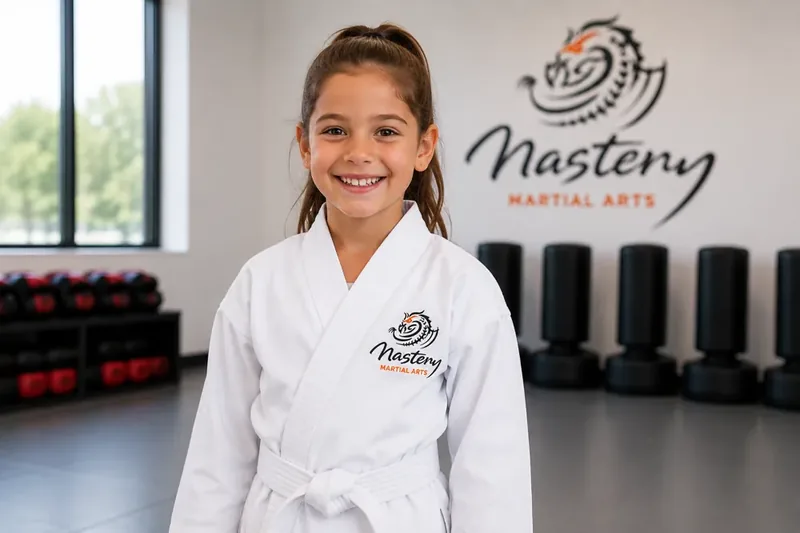
Troy parent: Wondering whether karate or taekwondo is better for your child? I hold black belt rank in both arts — here is the honest answer, plus a free class so you can judge the school instead of the label. You can see it in action at our kids karate classes in Troy, MI.
“Is this karate or taekwondo? And which one is better for my child?” I have been asked that question in our Troy lobby for 34 years, and I love answering it — because I am one of the few instructors who can answer from inside both arts. I hold four black belts — currently a 6th degree — including a 2nd degree in Tang Soo Do, which is literally “Korean karate,” a 2nd degree in Shorinji-Ryu karate, and a 1st degree in Tae Kwon Do.
So let me be upfront about something most schools never tell you: Mastery Martial Arts is a Tae Kwon Do–based school. We say “karate” because that is the word American families use for kids’ martial arts — the way people say Kleenex for tissue. By the end of this guide you will understand exactly what the two styles share, where they differ, and why the question that actually matters is a different one entirely. This article is part of our larger guide on karate vs other sports for kids.
To a 7-year-old, the difference between the styles is invisible. The difference between schools is everything.
Cousins, Not Strangers
Karate was developed in Okinawa and Japan, built around powerful hand strikes, blocks, and strong stances. Tae Kwon Do was formalized in Korea in the 1940s and 50s, and its founders were heavily influenced by Japanese karate — then made it their own with the dynamic, athletic kicking Korea is famous for. My own first art, Tang Soo Do, sits right between them: a Korean art so close to its Japanese roots that its name translates loosely as “the way of the China hand” — the same characters early karate used.
That family history is why the karate vs taekwondo for kids debate is smaller than it looks: the two arts are far more alike than different. Both use belt ranks. Both are built on respect, courtesy, and self-control. Both teach forms — karate calls them kata, Tae Kwon Do calls them poomsae. Both give a child a structured path from white belt to black belt where effort becomes visible progress.
Karate vs Taekwondo for Kids: What’s Actually Different
Kicks vs. hands
Tae Kwon Do is famous for kicking — fast, high, spinning, athletic. Karate keeps more balance between hand techniques and kicks, with deeper stances and an emphasis on decisive single strikes. In a kids’ class, this means a TKD-based program usually develops more lower-body athleticism, balance, and flexibility, while a traditional karate program spends more time on hand combinations and stance work.
Sport vs. tradition
Tae Kwon Do has been a full Olympic sport since 2000, so many TKD schools include light, controlled sport sparring. Karate joined the Olympics only briefly in 2021, and many karate schools lean more traditional. Either can be great — what matters is how much contact the school allows at what age, which is a question you should ask on your first visit.
The words on the wall
Karate schools count in Japanese and bow to “sensei.” Tae Kwon Do schools count in Korean and bow to “sabomnim.” Your child will happily learn either. No six-year-old ever quit martial arts over the vocabulary.
What’s the Same — and Why It Matters More
Here is what three decades of teaching has shown me: for children ages 3–12, the style on the sign predicts almost nothing about what your child will get out of martial arts. Both arts can build confidence, focus, discipline, and resilience. Both can also be taught badly. The variables that actually change your child’s outcome are the instructor, the curriculum, the class sizes, and whether the school teaches character on purpose or just techniques.
One of our black belts, Falak, walked in as a shy beginner and spent five and a half years growing into a confident leader who now mentors younger students — you can read her Black Belt Story. Nothing about that transformation came from the style being Korean instead of Japanese. It came from a curriculum built to grow a child, one stripe at a time.
Why We Say “Karate” at a Taekwondo-Based School
Some schools dodge this question. I would rather answer it. Our curriculum is Tae Kwon Do–based — Korean forms, Korean kicking — blended with the character-development system we have refined over 34 years. We call our children’s program “karate” because that is the word Troy parents search for and use at the dinner table. What you are really choosing is not a style. It is a school, a teacher, and a plan for your child. That is why every student here trains on a Personal Power Plan built around what they need — confidence for one child, focus for another.
How to Choose: Judge the School, Not the Style
Visit the school. Watch a class of kids your child’s age. Ask three questions: Do the kids look engaged or bored? Does the instructor know each child by name and need? Is character — respect, focus, perseverance — being taught as deliberately as kicking? Then let your child try a class, because their reaction will tell you more than any article. Still weighing whether martial arts fits at all? Read Is Martial Arts Right for Your Child? The American Academy of Pediatrics’ HealthyChildren.org echoes the same advice: program quality and instructor supervision matter more than discipline or style.
The Bottom Line
Karate vs taekwondo for kids is the question parents ask. School vs school is the question that decides your child’s outcome. Both arts are close cousins that build the same core skills — confidence, discipline, respect, and focus. Find the school that teaches those on purpose, whatever name is on the sign. And if you are in the Troy area, come watch what a Tae Kwon Do–based “karate” class looks like when it is built around your child — the first lesson is free.
Common Questions from Parents
Is taekwondo or karate better for kids?
Neither style is inherently better for children. Both build confidence, discipline, focus, and fitness. Taekwondo emphasizes dynamic kicking and is an Olympic sport; karate balances hand and foot techniques with deeper stances. For kids 3-12, the quality of the school, instructor, and character curriculum matters far more than the style.
Is taekwondo the same as karate?
They are closely related but distinct. Karate developed in Okinawa and Japan; Tae Kwon Do was formalized in Korea in the 1940s-50s and was heavily influenced by Japanese karate. Both use belts, forms, and similar values. Many American schools, including Tae Kwon Do-based ones, use the word “karate” because it is the term families know best.
What age should a child start karate or taekwondo?
Most children are ready for a structured martial arts class between ages 3 and 5, provided the school has true age-specific programs. At Mastery Martial Arts in Troy, MI, Tiny Tigers classes start at age 3 with 30-minute, high-engagement lessons designed for preschool attention spans.
Which is better for self-defense, karate or taekwondo?
For children, both provide comparable practical self-defense: awareness, confidence, balance, blocking, and escape skills. Bully-proofing comes more from the confidence and verbal boundary-setting a good school teaches than from any specific technique. Ask any school you visit how they teach bully prevention specifically.

Denny Strecker, Chief Instructor — Mastery Martial Arts, Troy MI
Denny holds four black belts — currently a 6th degree — with ranks in Tang Soo Do (Korean karate), Shorinji-Ryu karate, and Tae Kwon Do, and has taught children in Troy since 1992. Mastery has trained 2,500+ kids across Mastery schools. He is the author of two Amazon best-selling parenting books: How to Double Your Child’s Confidence in Just 30 Days and From Chaos to Calm. Every Mastery student trains on a Personal Power Plan built around their individual growth.
Whichever art you pick, ask to see the belt chart. Here is ours, with the character goal and typical timing on all 18 belts.
Keep Comparing
Part of our complete parent guide to choosing the right activity for your child.
Start HereKarate vs Other SportsThe complete parent comparison guide that ties these together.ComparisonKarate vs Jiu-JitsuStriking vs grappling — an honest look at both paths.ProgramKids Taekwondo in TroySee our Tae Kwon Do–based kids program up close.ComparisonKarate vs Team SportsIndividual progress vs team outcomes for growing kids.See the Difference a School Makes
Book a free 1-on-1 Introductory Lesson at Mastery Martial Arts in Troy, MI, and watch how your child responds on the mat. No pressure, no commitment.
Free Class · Troy, MI
See it for yourself.
Bring your child in for a free introductory lesson and 30 free days. No obligation to continue.
Get My Child’s Free 30-Day Pass →3656 Rochester Road, Troy · (248) 247-7353
For Parents
See our answers first on Google
Google now lets you choose the websites you trust most. The ones you choose move to the top of your search results. Add us, and our articles on focus, confidence, and bullying show up first, right when you’re looking for help. It takes ten seconds, and you can undo it anytime.
Make Us a Preferred SourceOpens Google. Tap the search box, then check the box next to “Mastery Martial Arts - Troy.”