
Mastery Martial Arts · Troy, MI
Social Confidence for Children
Troy parent: If your child is shy, anxious in groups, or slow to make friends, our classes are built to turn quiet kids into confident ones, one small win at a time.
Social confidence for children is a skill parents can help build. This complete guide covers what social confidence is, why kids struggle, the five building blocks, and how martial arts in Troy MI helps shy children make friends and speak up. For daughters specifically, see our karate for girls in Troy, MI program.
Home › Blog › Social Confidence for Children Complete Parent GuideA practical guide for parents whose child is shy, slow to make friends, or unsure of themselves around other kids, and a clear path to help them feel at home in any group.
If you have ever watched your child stand at the edge of a group of kids, wanting to join in but not quite able to take the step, you already understand what social confidence is. It is the quiet belief that says, “I belong here, and I am okay to be seen.” Some children seem to be born with it. Most are not. For the majority of kids, social confidence is a skill that gets built slowly, through dozens of small wins, supportive adults, and a lot of practice.
This guide is written for parents in Troy and the surrounding communities who want to help a child who is shy, anxious in groups, slow to make friends, or simply unsure of themselves around other kids. My name is Denny Strecker, and I have spent more than three decades teaching children through martial arts and writing two best-selling books for parents on raising confident kids. The patterns below come from watching thousands of children walk in nervous and walk out a little taller.
What Social Confidence Actually Is
Social confidence is not being loud, being the center of attention, or never feeling nervous. Plenty of confident children are quiet by nature. What they share is not volume, it is a sense of safety in their own skin. A socially confident child can make eye contact, start or join a conversation, recover from an awkward moment, and handle being told no without falling apart.
It helps to separate three things that parents often blend together. Temperament is how your child is wired, and a naturally cautious child is not broken. Social skills are the specific, teachable behaviors like greeting someone or taking turns. Social confidence is the willingness to use those skills even when it feels risky. A child can know exactly what to say and still freeze, because confidence, not knowledge, is the missing piece.
Why Some Kids Struggle Socially
There is rarely a single cause. A naturally sensitive temperament, a few early experiences of rejection, more screen time and less face-to-face play, or simply fewer chances to practice can all add up. None of these mean something is wrong with your child. They mean your child has had less repetition than a peer who happens to find groups easy.
One trap parents fall into is assuming that signing a child up for a busy team will fix it. For many kids it does not, and sometimes it makes things worse. I wrote a full breakdown of this in our article on why team sports do not help every child socially, because the reason is important and surprises a lot of parents.
The Five Building Blocks of Social Confidence
1. A feeling of physical safety
Children read body language before words. A child who feels physically settled, who is not bracing for teasing or chaos, has the spare attention needed to be social. This is one reason a calm, structured environment helps shy kids so much.
2. Repeated small wins
Confidence is the memory of having succeeded before. Every time a child raises a hand, holds a door, or finishes something hard, the brain files away evidence that says, “I can do this.” Stack enough of those and a shy child slowly rewrites the story they tell about themselves.
3. The words and the practice to use them
Knowing how to break into a group, ask a question, or handle a disagreement is learnable. Most kids are never explicitly taught these moves, they are just expected to figure them out. Our guide on how kids make friends walks through the exact steps you can rehearse at home.
4. The ability to lead and to speak up
Confidence grows fastest when a child gets to be the one in front, even briefly. Helping a newer student, leading a warm up, or simply speaking clearly to a group builds a muscle most kids rarely use. We cover this in depth in leadership and communication skills for kids.
5. A way back from setbacks
Resilient kids are not kids who never fail. They are kids who have learned that a stumble is not the end of the story. Teaching a child to recover, to try again after a missed friendship attempt or a hard day, is what turns a one-time win into lasting confidence.

How Martial Arts Builds Social Confidence for Children
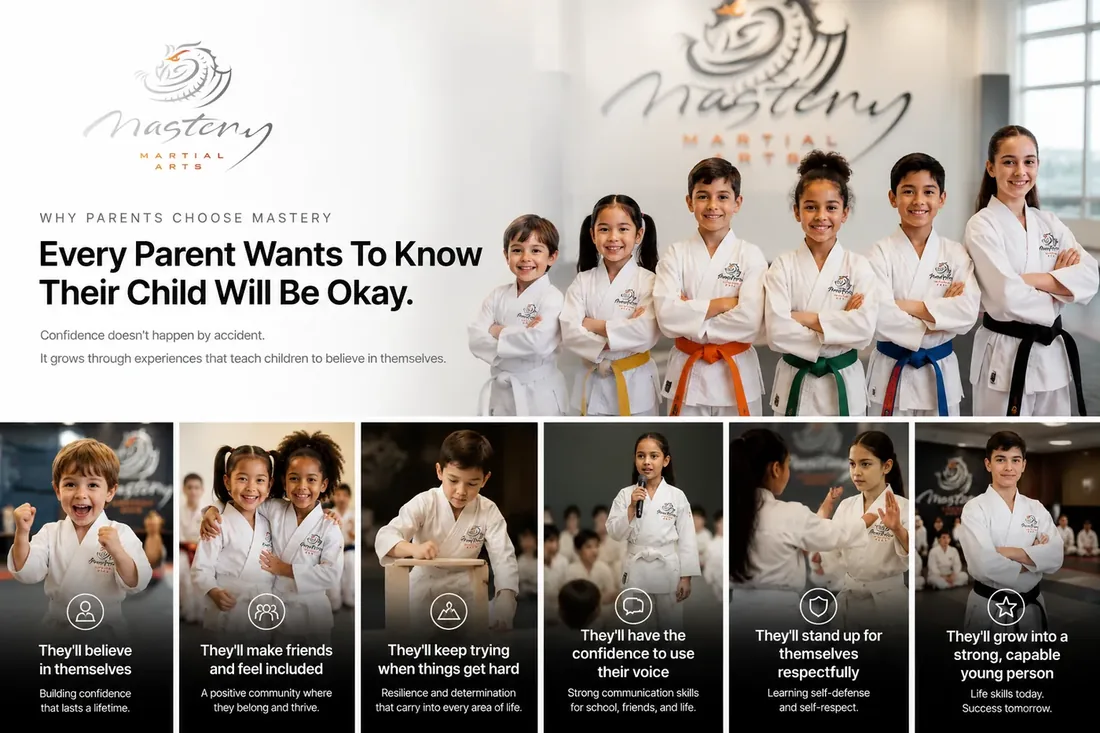
A good martial arts class is, by design, a confidence machine. The structure is predictable, so an anxious child knows what to expect. Progress is visible, with belts and stripes that turn effort into proof. And every class involves talking to partners, bowing in, answering instructors, and eventually leading. The child who would never raise a hand at school will, within a few months, shout a loud “Yes Sir” and demonstrate a technique in front of the room.
It also works because confidence built through the body is hard to argue with. A child who has broken a board, held a plank longer than they thought possible, or earned a new belt has physical, undeniable evidence of their own capability. That evidence travels. It shows up on the playground and in the classroom. If your child is on the quiet end, our specific guide to martial arts for shy kids explains how a careful start makes all the difference.
What Parents Can Do at Home
You do not have to wait for a class to start. Narrate confidence by naming the brave thing your child did, not just the outcome. Resist speaking for your child at the restaurant or the store, and let them order or ask the question even when it is slow and a little painful to watch. Set up low-stakes practice, like one playdate with one child rather than a big party. And protect unstructured, face-to-face play, which is where most social practice naturally happens.
Most of all, be patient with the pace. A cautious child who makes one small move per week is making real progress. Confidence that is built slowly tends to be the kind that lasts.
When to Seek Extra Help
Most social shyness is well within the normal range and responds beautifully to practice and patience. If your child shows lasting distress, avoids school, has panic-level reactions to social situations, or seems to be losing skills they once had, it is worth talking with your pediatrician or a child counselor. Building social confidence and addressing deeper anxiety are not mutually exclusive, and a good professional can help you tell the difference.

Start With One Small Step
Social confidence is not a personality you are born with, it is a skill set you can help your child build. Pick one of the articles below to go deeper on the area your child needs most, then give them a place to practice. At Mastery Martial Arts in Troy, that practice happens every single class, in a room built to make quiet kids feel brave.
The Social Skills Series
This pillar guide connects to four deeper articles. Start with the one that fits your child best.
Start Here Martial Arts for Shy Kids Why a quiet, structured start helps reserved children come out of their shell. Friendships How Kids Make Friends The step-by-step social moves you can rehearse with your child at home. Communication Leadership and Communication Skills How leading, even briefly, turns a hesitant child into a confident one. Read This First Why Team Sports Do Not Help Every Child Socially The surprising reason a busy team can leave a shy child more isolated.Ready to Help Your Child Feel Confident Around Other Kids?
Book a free 1-on-1 Introductory Lesson at Mastery Martial Arts in Troy, MI. No pressure and no commitment, just a chance to see your child take a first confident step.
Get My Child’s Free 30-Day Pass →3656 Rochester Road, Troy · (248) 247-7353