Mastery Martial Arts · Troy, MI
Your Child Can Only BecomeWhat They’ve Been Exposed To
How Mastery Martial Arts – Troy Is Shaping Who Your Child Becomes — One Class at a Time
Kids Karate Classes | Troy, MI | Ages 3 to 17
Kids karate classes Troy MI parents trust most aren’t just teaching kicks and punches — they’re building identity. There is a principle quietly at work in every child’s development — one most parents have never heard named, but that shapes everything about who their child ultimately becomes:
Children can only imagine becoming what they have been exposed to. Exposure quietly defines possibility.
Read that again. Let it land.
It means your child’s ceiling isn’t determined by their talent, their test scores, or even their potential. It’s determined by what they have seen, lived alongside, and been immersed in. The environments that surround them are writing a story about who they are allowed to be — and they’re writing it right now, whether you’re intentional about it or not.
That’s not a scary idea. It’s one of the most empowering truths in child development. Because it means that if you want to raise a disciplined, resilient, confident, respectful young person — you don’t have to hope they figure it out on their own. You have to build the right environment around them. Learn more about our kids karate program or explore our Little Dragons classes for younger children.
That’s exactly what Mastery Martial Arts – Troy does. Our kids karate classes in Troy MI are designed around this principle — every single class.
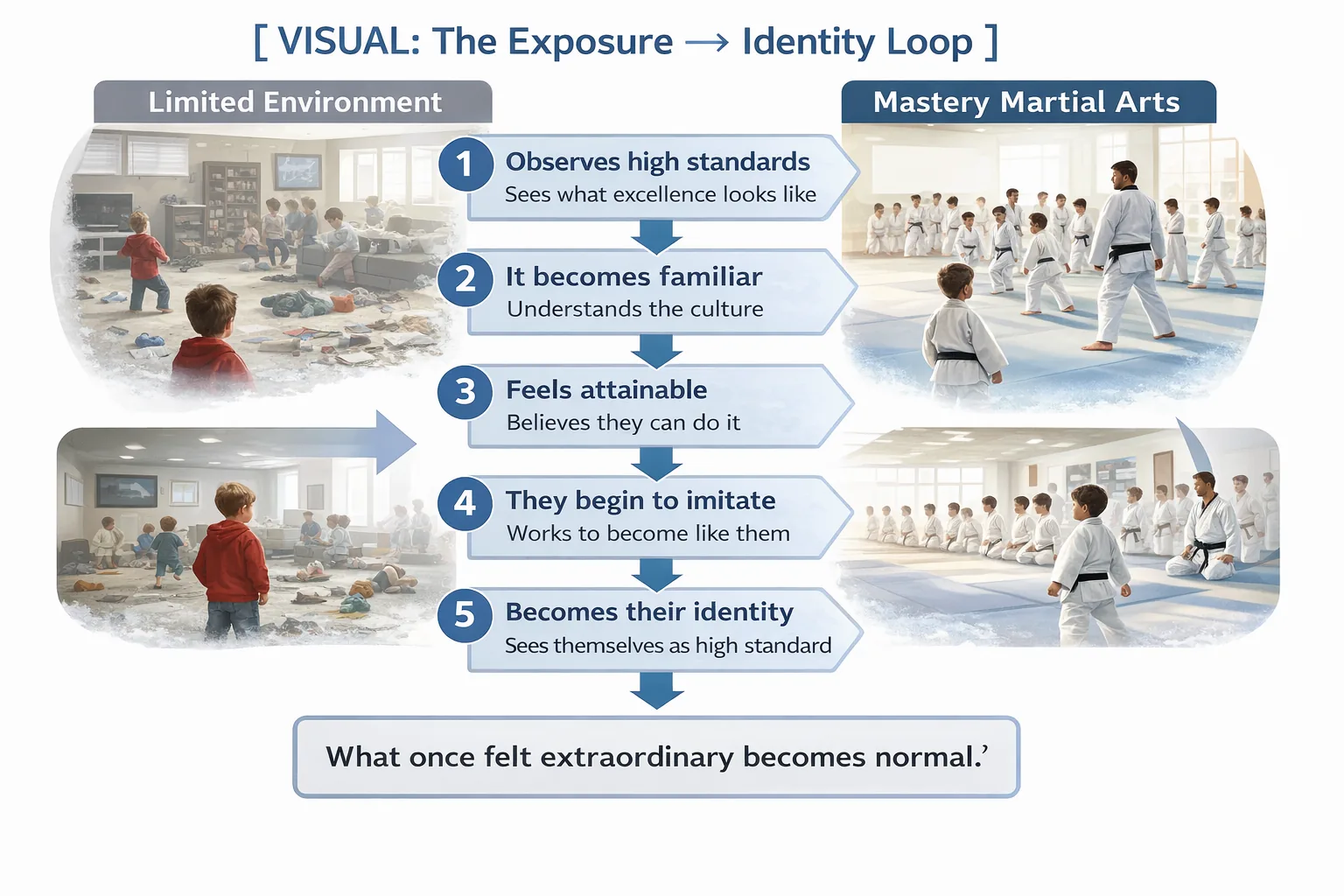
The Exposure → Identity Loop: What once felt extraordinary becomes normal.
Why the Brain Makes Exposure So Powerful
Your child’s brain is not a blank slate. It’s a relentless pattern-recognition engine, constantly asking one question about everything it encounters: Is this normal? And “normal” is determined almost entirely by what shows up repeatedly in their world.
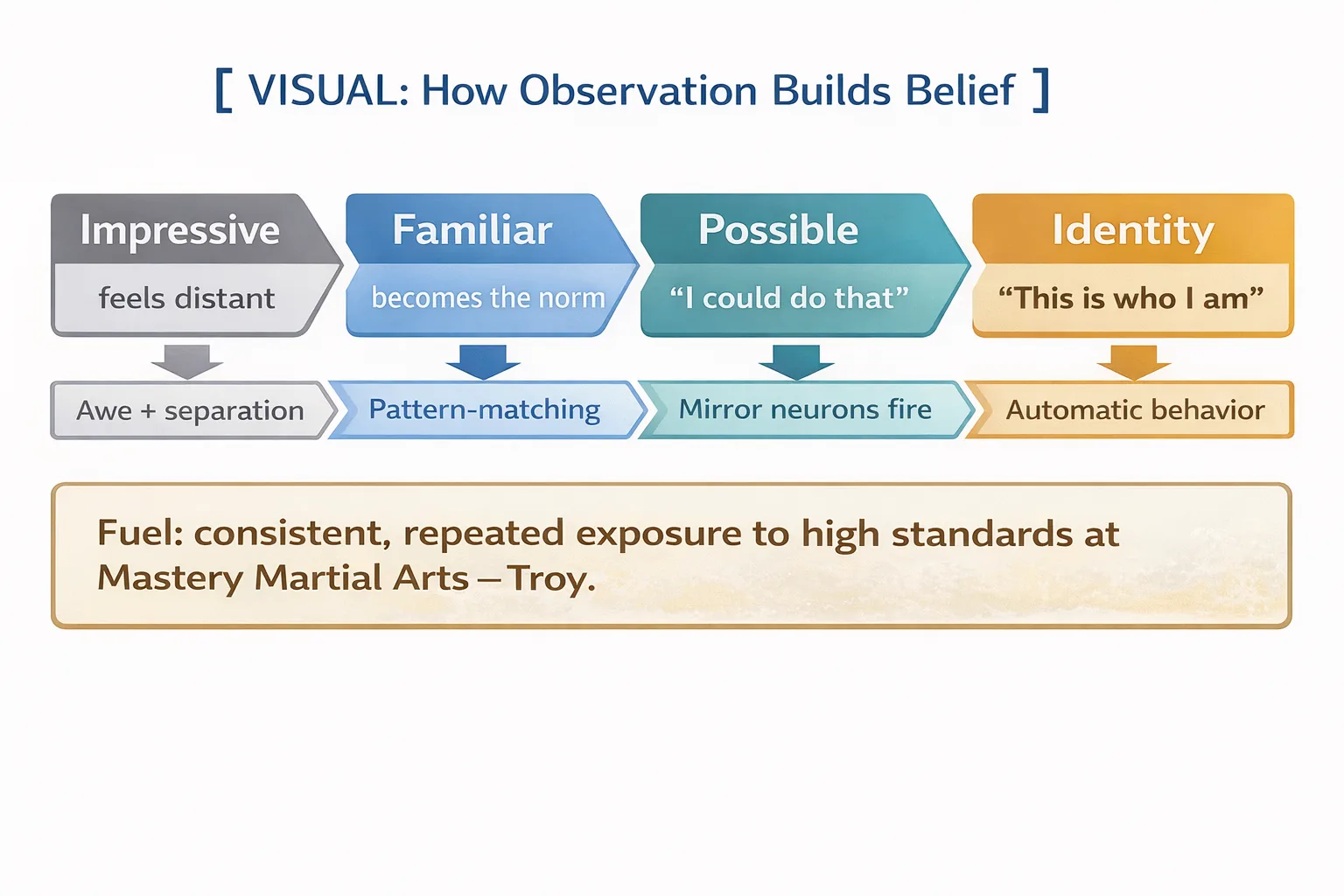
Psychologists call this the mere exposure effect. The more frequently a child encounters a behavior, a standard, or a way of carrying themselves, the more their brain reclassifies it — from “impressive” to “familiar,” and eventually from “familiar” to “just how things are.” That reclassification is the beginning of identity.
This is why it matters enormously where your child spends their time. Not what you tell them. Not what you post on the refrigerator. Where they are — week after week, year after year.
Research published in the Journal of Applied Developmental Psychology found that after just three months of consistent martial arts training, children showed measurable improvements in cognitive self-regulation, prosocial behavior, and focus — not because anyone lectured them, but because the environment they trained in made those traits feel normal and expected.
The environment did the work. That’s the whole point.
Step 1Observation —
When Seeing Becomes Believing
It starts the moment your child steps onto the mat.
They see students bowing in with genuine focus. They see an older child hold a difficult position without flinching. They see an instructor demonstrate a technique with poise and precision, then turn around and offer patient encouragement to a nervous beginner. None of it is accidental. All of it is deliberate.
In that first class — and the second, and the third — something important is happening inside your child’s brain. Even before they perform a single technique, they are building a mental map of what people look like when they lead with discipline, push through discomfort, and treat others with respect.
Before a child can do something, they have to be able to picture someone like them doing it.
This is why role models matter so much more than we often acknowledge. A child who has never seen resilience in action doesn’t decide to be resilient. They never even consider it an option. Not because they can’t — but because it hasn’t entered their world yet. Observation is how it enters.
Why observation at Mastery Martial Arts is different
A child can watch an Olympic athlete on television and come away inspired — but almost never thinking “that’s for someone like me.” The gap is too large. There are no bridges.
At Mastery Martial Arts – Troy, the gap is closed by design. Your child isn’t watching a distant champion. They’re standing next to a twelve-year-old who started where they are. They’re watching a peer who struggled with the same technique last month nail it today. They’re seeing what the next six months of effort actually looks like — in human form, right in front of them.
That’s not just inspiration. That’s exposure. And exposure, repeated consistently, is what builds belief.
Step 2Familiarity —
When High Standards Become the Baseline
Here is where the real magic begins — quietly, invisibly, between classes.
Every time your child returns to the mat, the brain logs another data point. Effort is normal here. Respect is expected here. People push through hard things here. After enough repetitions, something fundamental shifts: the behavior stops being classified as remarkable and becomes simply what people do. The brain has built a new baseline.
This is the baseline shift — and it may be the single most important thing that happens at Mastery Martial Arts. Not a specific technique. Not a particular belt. The quiet redefinition of what your child considers ordinary.
What a child sees every week becomes what they believe is possible every day.
The two types of children — and the only difference between them
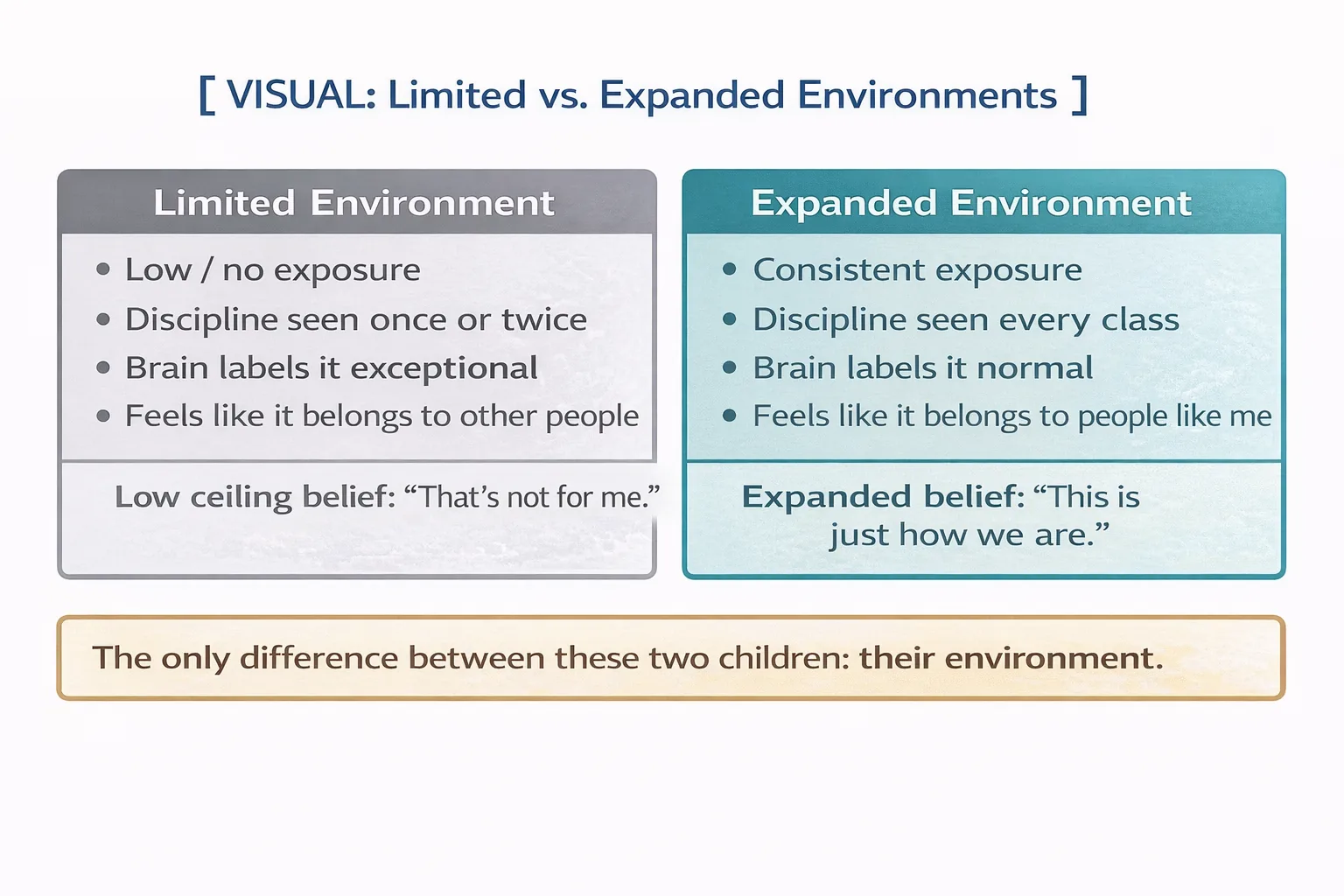
Consider two children the same age, with the same raw potential. One grows up in an environment where effort is optional, discipline is rarely modeled, and quitting when things get hard is treated as understandable. The other spends two evenings a week in a place where everyone around them treats effort as the baseline, discipline is visible in every interaction, and pushing through is simply what’s done here.
Five years later, those two children will think about themselves very differently. Not because one was born with more. But because one’s brain built a higher baseline.
That second child can be yours. That environment is Mastery Martial Arts – Troy.
Step 3Attainability —
“I Could Actually Do That”
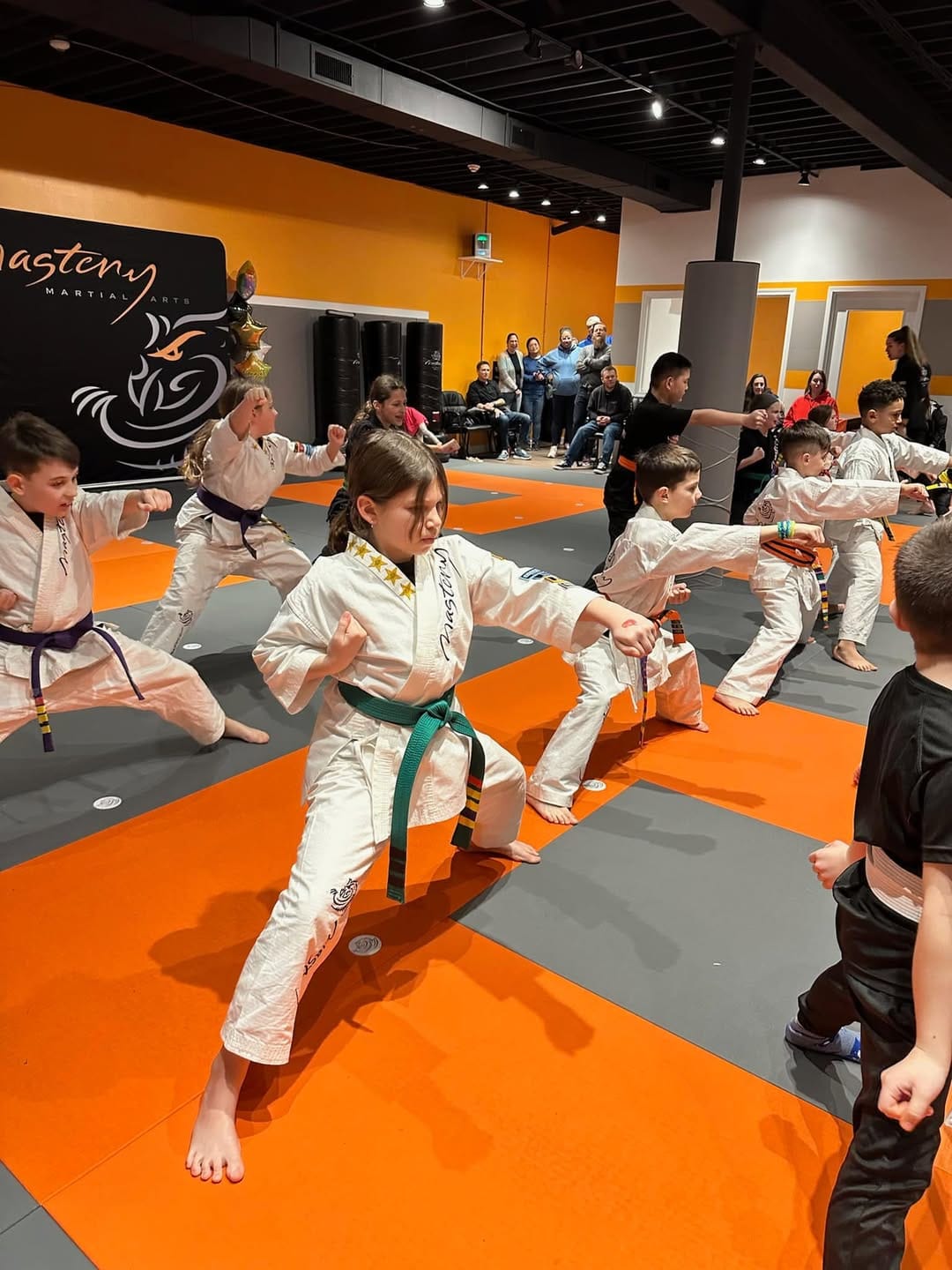
Familiarity gets a child to recognize a standard. Attainability is what makes them reach for it. These are two very different psychological events, and the distance between them is where most environments fall short.
A child can be familiar with excellence — they’ve seen it, they know what it looks like. But unless they believe it is specifically possible for someone like them, belief never forms. The gap between admiration and aspiration stays open.
What closes that gap is seeing enough intermediate steps that the journey feels navigable. And that’s precisely what the belt system at Mastery Martial Arts does.
The belt system as a belief-building architecture
Think about what your child sees on the mat at any given class. They see every stage of the martial arts journey in the same room simultaneously — from the white belt who started last month to the Black Belt who has been training for years. Every belt in between is a visible proof point: this path is real. This path has been walked by real people. Real people who started exactly where I am standing.
Neuroscience confirms why this is so powerful. Research on mirror neurons — the specialized brain cells that fire both when we perform an action and when we observe someone else doing it — shows that watching an attainable model doesn’t just inspire a child. It literally activates the same neural pathways as doing the thing themselves. The brain begins simulating the journey before the child ever consciously decides to take it.
That simulation is the beginning of belief. And belief is the beginning of everything.
The “people like me” filter
Every child’s brain runs a constant background check before allowing belief to form: Does this apply to people like me? It’s not conscious. It happens automatically.
This is why who your child trains beside matters as much as what they’re taught. When a child watches a slightly older peer — someone who fidgeted in class, who took a few months to get the technique right, who looks and acts a lot like them — earn their next belt, the filter passes. The brain says: that’s someone like me. Which means this is something for someone like me.
That moment of attainability is irreplaceable. And Mastery Martial Arts – Troy creates it, consistently, every single class.
Step 4Imitation —
When Watching Becomes Doing
Here is where everything changes. Attainability tips into action, and the child stops being a spectator of excellence and starts becoming a practitioner of it.
There is a common misunderstanding that imitation is somehow shallow — that a child copying what they see is just mimicking, not growing. The science says the exact opposite. Imitation is the brain’s primary learning mechanism. It is not a shortcut to identity. It is the path.
The three memories that make imitation stick
When a child imitates a behavior at Mastery Martial Arts, three distinct types of memory get encoded simultaneously. It’s the combination of all three that eventually produces lasting identity change.
💪Motor Memory
The body learns to do it. The bow, the stance, the controlled breath before a technique. Repeated enough times, the body executes without the brain issuing a conscious command. The same principle applies to behavioral patterns — responding to frustration with focus instead of a meltdown is also a motor pattern. Do it enough times and it stops requiring a decision. It just happens.
❤️Emotional Memory
The behavior starts to feel right. Every time a child pushes through something hard and comes out the other side, the brain tags the experience: effort leads to accomplishment. Pushing through feels good. Over time, discipline becomes emotionally rewarding — not because anyone told them it should be, but because their own nervous system learned to associate it with pride and satisfaction.
🌟Social Memory
The behavior feels like theirs. Every time an instructor notices a child’s effort, every time a peer acknowledges their growth, every time they bow out knowing they gave everything — the brain updates its social self-image. I am someone who does this. Other people see me as someone who does this. This is part of my story.
Motor memory. Emotional memory. Social memory. All three fire at once on the mat. That’s why what happens at Mastery Martial Arts doesn’t stay at Mastery Martial Arts.
Why the dojo is such a powerful identity forge
Most environments in a child’s life are passive. School delivers content. Sports build coordination. But neither is explicitly structured to trigger repeated, visible imitation of high-character behavior — with immediate social feedback — class after class after class.
Mastery Martial Arts – Troy is an active imitation environment. The instructor demonstrates — your child imitates. The senior student models — your child observes and then tries. The technique is corrected — your child adjusts and improves. Every element of the class structure is designed to move behavior from the outside in.
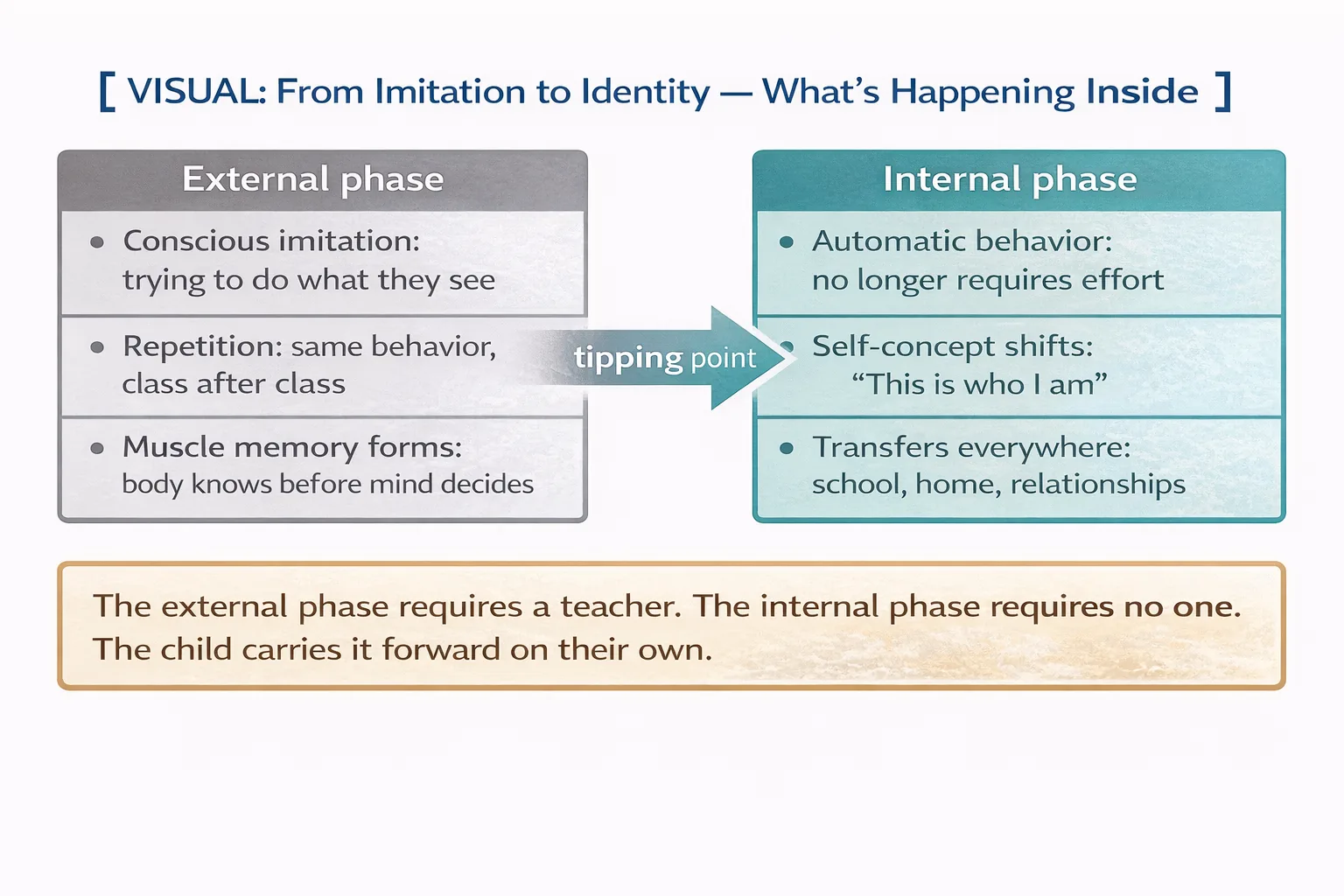
From Imitation to Identity: The external phase requires a teacher. The internal phase requires no one.
Step 5Identity —
When Discipline Just Becomes Who They Are
This is the destination the whole journey has been building toward. And it looks very different from what most people expect. It’s quieter. Less dramatic. And that’s exactly what makes it so powerful.
Discipline as identity doesn’t look like discipline anymore
When discipline becomes identity, the struggle disappears. Not because the child became perfect, but because the behavior stopped requiring a decision. It moved from the front of the brain — where willpower and effort live — to somewhere much deeper, where automatic, self-defining behaviors live.
The clearest sign that discipline has become part of a child’s identity is simple: they do it when no one is watching.
The goal isn’t a child who tries to be disciplined. The goal is a child for whom discipline is simply part of how they move through the world.
What parents actually notice at home
Parents of children who have trained consistently at Mastery Martial Arts for a year or more describe the same quiet shifts. They’re worth naming:
The child starts organizing their own space and belongings without being asked. The standard from the mat has leaked into the bedroom, the backpack, the homework routine.
They handle frustration differently. Not perfectly — they’re still kids. But there’s a pause now where there used to be an immediate reaction. That pause is everything. It means the nervous system has learned that difficulty is a signal to reset — not to quit.
They carry themselves differently in unfamiliar situations. A child whose identity includes respect and self-control doesn’t suddenly lose it when entering a new school, meeting a new coach, or facing an uncomfortable conversation. Those traits travel with them.
They hold themselves accountable. Not because a parent is watching, but because that is what people like them do.
When you ask them why they do these things, they often can’t articulate a reason. They just shrug: “that’s just how I am.” That shrug is the whole point.
Discipline as a Rule vs. Discipline as Identity
| Discipline as a Rule | Discipline as Identity |
|---|---|
| Requires reminding | Self-initiated |
| Present when observed | Present when no one is watching |
| Tied to the environment | Travels with the child |
| Feels like effort | Feels like self-expression |
| Collapses under pressure | Strongest under pressure |
| Enforced from outside | Generated from inside |
| The goal of Mastery Martial Arts is not the left column. It is building children who live entirely in the right column. | |
The Transfer Effect:
Why It Shows Up Everywhere
One of the most important things to understand about identity-level discipline is that it doesn’t stay contained to the context where it was built.
A child who developed grit on the mat doesn’t leave grit in the parking lot when they go to school. A child who internalized respect during bow-ins doesn’t forget it at the dinner table. A child who learned to reset under pressure during a sparring drill uses that same skill during a difficult exam, a conflict with a friend, a moment where everything feels hard.
This is the transfer effect — and it’s what separates a structured martial arts program from almost every other children’s activity. The skill being built isn’t kicking. It isn’t even focus, exactly. It’s a self-image: a durable, portable sense of I am someone who shows up, pushes through, and treats people well. That self-image goes wherever your child goes — for the rest of their life.
A comprehensive review published in the Journal of Sports Science and Medicine analyzed more than 350 research papers on the social-psychological outcomes of martial arts training in young people and confirmed that the benefits — improved self-concept, reduced aggression, greater respect, stronger self-regulation — transferred broadly across life domains. Not just on the mat. Everywhere.
Mastery Martial Arts isn’t building a hobby. It’s building a person.
Why Kids Karate Classes Troy MI at Mastery
Are Built for This
Most activities in a child’s life are passive environments. They happen to a child. Mastery Martial Arts – Troy is a deliberately designed exposure environment — one built from the ground up to move children through every stage of the exposure-to-identity loop, consistently, week after week.
Every element of the program is a deliberate exposure opportunity:
- Instructors who lead with visible discipline, genuine warmth, and high expectations — modeling the standard your child will eventually internalize as their own.
- A belt progression system that places every stage of the journey in the same room, giving your child a visible, navigable ladder from where they are to where they could be.
- A culture where effort is the baseline, respect is practiced not just preached, and every child is seen and recognized for growth — not just performance.
- Consistent, structured repetition across months and years — the exact condition the brain requires to convert imitation into identity.
- A community of peers who are all building the same standards, so that the environment reinforces the values from every direction at once.

The question parents should be asking is not whether their child will be shaped by the environments around them. They will be. Every child is, every day. The question is:
Which environments are doing the shaping?
You get to answer that question. And the answer you choose right now — the environments you build around your child today — will write the story of who they become.
34+ Years of Excellence 2,500+ Kids Across Mastery Schools 4.9★ Google Rating 277 Google Reviews4.9 ★ on Google · 277 reviews
“My son really enjoy being at Mastery Martial Arts. The program goes far beyond teaching martial arts techniques. It focuses on building confidence, discipline, respect, leadership and resilience in children.”
Sourabh Garg, Google review
“Excellent facility! My 4 year old really enjoys coming to his martial art classes. Denny, the instructor, is very good at making the class educational and fun at the same. The kids are learning through playing.”
Elaine Wang, Google review
“Before stating karate my daughter refused to clean up after herself. Now she goes above and beyond with her chores, even asks what else she can do around the house. She cleans her room every night before bed!”
Anna Birchmeier, Google review
“Great experience with Troy Mastery Martial Art. I see much more improvement in my kid compared to the previous karate class where we went.”
M K, Google review
Ready to Expand Your Child’s World?
Give your child consistent exposure to discipline, leadership, and resilience — and watch what happens to their identity. The environment is ready. The instructors are waiting. The only thing missing is your child.
Research & Sources
1. Lakes & Hoyt (2004) — Promoting self-regulation through school-based martial arts training. Journal of Applied Developmental Psychology.
2. Positive Psychology — Mirror Neurons and the Neuroscience of Empathy: How We Learn Through Imitation and Observation.
3. Vertonghen & Theeboom (2010) — The social-psychological outcomes of martial arts practice among youth. Journal of Sports Science and Medicine.
Get My Child’s Free 30-Day Pass →3656 Rochester Road, Troy · (248) 247-7353